Women and Wetlands: Invisible Work, Visible Impact
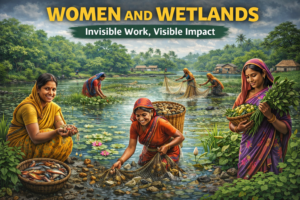
West Bengal is rich with natural and man-made wetlands, both freshwater and brackish water. Total wetland area of the state has been estimated at 10.49 lakh ha (freshwater area: 5.89 lakh ha, estuarine area: 2.5 lakh ha and brackish water area: 2.1 lakh ha), excluding paddy fields. Amongst these ecological types, freshwater wetlands, such as, pond, pool, beel, baor, haur, jala, doba, daha, dighi, sagar, sayer, etc., are distributed widely all over West Bengal. And amongst these freshwater wetlands, womenfolk are especially concerned with smaller water bodies, shallow marshes and lowland depressions like dobas, jheels, jalas, paddy fields and roadside nullahs those offer suitable sites for fishing small indigenous fishes and shrimps, and also for collecting edible freshwater snails, mussels and crabs. Rural women regularly depend on these wetlands for collecting edible plant food materials for domestic consumption as well as ethnomedicinal plants for cure of various ailments.
There is no shortage of evidence and research showing just how important women have been in protecting the environment. Nevertheless, there is a significant need to enhance knowledge of the specific processes women implement in their strenuous work of conserving and protecting wetlands. Women, especially those embedded in local communities across the country, are doing a lot of stuff every day to save wetlands, and this has to be acknowledged.11 Their extraordinary dedication and effort act as catalysts and inspire more sustainable behavior in areas concerned with environmental conservation. Nearly 50% of the population is female. In many countries, women contribute in fisheries occupations as fishers which account for important parts of local communities and indigenous people. These women depend on natural resources for their living and as a primary source of nutrition.
Shocking figures now show that in the last 200 years, human activity has destroyed at least 60% of ecological wetlands. This devastation underscores the pressing need for a global, inclusive strategy to safeguard and rebuild these priceless ecosystems. It is important to note that in achieving this objective, there is a need to appreciate the role of women in wetland conservation. Women bring invaluable knowledge and experiences that will enable sustainable strategies for wetland conservation.
Many times, women’s involvement in different environmental management activities ensures conservation outcomes and the long-term success of institutions governing the environment. Rural women are known as the ‘custodians of nature’ because of their gender-defined roles in agriculture and their high dependence on ecosystems for water, firewood, medicine, and other goods. They gather, grow, and harvest many resources within the wetland itself or from areas directly surrounding it.12 In many parts of Africa, women control the allocation of resources. Ensuring that women’s views and perspectives are taken into account and their involvement in planning and implementation may mean the conservation of not only a small portion of land but of the whole wetland ecosystem. 13 This is another reason to justify why women should be involved.
References: