
Wetlands of Bengal: Convergence of Nature, Culture and Livelihoods
By Samriddha Chakravorty
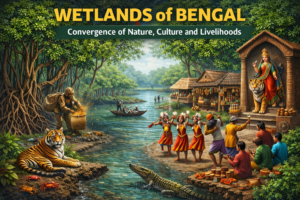
Wetlands are the ecosystem around a water body. To be specific it is the place where land meets water and the species present around it plays important role in balancing the ecosystem. Not only for balancing the ecosystem or for protection of the environment, it is also favored for the sceneric beauty it provides, with unique cultural practices that is acknowledged by people. For Example, Sundarban, being the largest mangrove forest in the world, attracts many tourists across the world. Visitors visit Sundarban, to enjoy the beauty of the jungle and their local culture. Besides giving shelter to many wild lives, it also supports the locals as they can perform fishing, honey collectors collect honey and wood cutter cuts wood of the jungle.
Sundarban is mainly known for its dense stands of Sundari Tree, Avicennia, and Rhizophora. It creates a cathedral like arch, with breathing roots of mangroves. Apart from these, there are many other plants like Hethal Tree, known for the hiding place of Royal Bengal Tigers. Sundarban is mainly known as house of Royal Bengal Tigers. Apart from them there are deers, monkeys. The water of Sundarban is known as house of crocodiles. It is that place, where the danger of land meets with the danger of water. Maybe it also symbolizes that it is the perfect example of a wetland where land meets water. Apart from crocodiles there are several small sharks, Monitor Lizards stays in the water of Sundarban. There are various crabs found in this region like Red Crab, Horse-shoe Crab and many others. It is the perfect place for the wildlife lovers to visit and explore the beauty of Sundarban.
There is a place called Pakhirala, where tourists stay and enjoy the culture of Sundarban. The Adibashi Dance show has become an essential for tourists, where the villagers sings and dances to their traditional songs. Visitors also accompany them and there happens a cultural exchange. Also in Pakhirala, many shops sells jewelry and stationaries made up of their native woods. The most famous sell is of raw honey sell, which the villagers, risking their lives, brings from the honeycomb of the jungle.
The lives of the locals near Sundarban are very hard. Often they are attacked by the Tigers when they go for cutting woods in the jungle, gathering honey from the hives and going for fishing. Their life is always at risk. Before stepping in the jungle, the villagers worship to Ma Bonbibi, believing that she will protect them from any danger. This is also one of their cultures. Despite of all the hurdles they face, having faith on Ma Bonbibi, they continue their work for earning and living. They go for cutting woods, gathering honey and fishing. Villages which are much closer to the jungle are at high risk of tiger attacks. More often we get to hear about tiger attacks in villages.
Besides being the area where land and water meets, wetlands are also the places where nature, culture and livelihood meets. Nature means the ecosystem. The species and habitats we get around it, the significance of it and also how the locals of that area use it or takes benefit from it. What activities they perform in or around that wetland is of high importance.