
Wetlands: Bengal’s Hidden Shield Against Climate Chaos
By Samriddha Chakravorty
Bengal is the one of the most flood prone states in India. It comes in third position after Bihar, being the most state in India. 42% of West Bengal has flood-prone area. In 41 years of analysis, the state faced severe floods in most of the years. The recent recent floods include, Kolkata flash flood in September 2025, Mirik rain and Landslide event in October 2025. In mid-September, 2024, there was a flood that resulted in 3 deaths and affected numerous people across many districts including Howrah, Hoogly, Paschim & Purba Medinipur, Bankura and Purulia. Apart from flood, there are several other natural calamities that affects West Bengal like Cyclone, Landslides and many others. West Bengal is also known for facing most cyclones for several years. Every year we get to see cyclones without any fail. The only difference we get to see is the effect of it. Sometimes it causes huge loss and sometimes it becomes mild. The most affecting cyclones in recent years are Amphan in 2020 and Yaas in 2021. These cyclones caused severe damages, affected the coastal and inland parts, impacting millions and huge infrastructure losses.
The natural calamities in West Bengal have significantly increased over the years. The reason behind it is sea surface warming and climate change which leads to more heavy rainfall, cyclonic disturbance and the risk of flood in the coastal region. Wetlands behave as natural shields against floods and cyclones.
Wetlands are areas around a water body or where water is the main factor. It controls the environment, plant and animal life. These areas are not fully covered by land or water rather it is in between the two. The soil in this area remain saturated with water for longer periods. Mangroves of Sundarban and East Kolkata Wetlands are the famous wetlands in West Bengal.
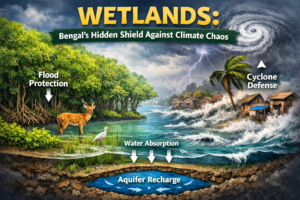
Wetlands absorbs and stores excess rainwater during heavy rainfall. This prevents river from overflowing. That is why wetlands are said to have sponge effect. Just like the marshy mangrove forest of Sundarban in West Bengal holds the flood water temporarily, the speed of the water flow is reduced by the dense vegetation which also prevents soil erosion and flood damage. The stored water seeps into the ground slowly which results in aquifers recharge. This lowers surface water pressure during the flood. The plants found in Wetlands, binds soils with their roots. In Sundarban we get to see plants with supporting roots that holds the soil protecting it from riverbank collapse and silt movement.
Wetlands also act as a buffer against cyclones. Coastal wetlands like mangroves forest absorbs the storm surge energy. They can reduce wave height and speed before it can reach the land. Mangrove reduces the wave energy around 60 – 90%. The trees and vegetation breaks down the wind speed, protecting the inside land areas. They also trap the sediments and stabilizes the coastlines which prevents land losses during cyclones.

Wetlands in West Bengal, especially Sundarban mangroves acts as a natural defense against climate change. They absorbs flood water and cyclones protecting the low lying delta region.